The Silent Sentinel of Melaka: My Years with A Famosa
I first encountered A Famosa not in a history book, but through the soles of my feet. It was a sweltering afternoon in Melaka, the kind of heat that seems to rise from the ancient cobblestones themselves. I’d wandered away from the bustling Jonker Street market, seeking a sliver of shade, and found myself face-to-face with a weathered, cream-colored gatehouse. It looked oddly small, almost humble, nestled against a manicured hill. This was the Porta de Santiago, the last stubborn fragment of a fortress once called “A Famosa”—The Famous. I remember resting a hand against its sun-warmed stone, the rough texture a stark contrast to the glossy, air-conditioned museums I’d just left. In that moment, I wasn’t just looking at a tourist attraction; I was touching a hinge of history. That casual encounter sparked a fascination that has drawn me back to Melaka countless times, not as a casual visitor, but as someone trying to listen to the stories this old stone refuses to forget.
From Mighty Fortress to Fragile Relic: The Weight of History
To understand A Famosa is to understand the brutal, competitive chess game of 16th-century global empire. Before the Portuguese admiral Afonso de Albuquerque arrived in 1511, Melaka was the thriving heart of the spice trade, a sultanate that commanded the narrow strait connecting the Indian Ocean to the South China Sea. Its conquest was a masterstroke, intended to strangle Venetian and Arab trade routes and cement Portuguese dominance.
The fortress they built, A Famosa (or Fortaleza de Malaca), was a statement in stone and mortar. It wasn’t just a military outpost; it was a physical manifestation of ambition. At its peak, the fort sprawled across the hill, a massive complex of thick walls, ramparts, and four major towers or bastiões—São Pedro, São Domingos, São Tiago, and the Madre de Deus. It enclosed a small town within its walls: a governor’s palace, a hospital, churches, and quarters for hundreds. For 130 years, it was the linchpin of Portuguese power in the East, a symbol of impregnability that withstood repeated assaults.
But history is rarely kind to symbols. In 1641, after a grueling eight-month siege, the Dutch East India Company (VOC) wrested control. They repaired and reinforced the fort, renaming it “Vlissingen,” but their architectural signature is most clearly seen in the red bricks they used, still visible today in the surviving gate. For another 150 years, the fort changed hands, a prized trophy in European conflicts, eventually falling under British administration in the early 19th century.
Then came the near-total erasure. In 1806, with the Napoleonic Wars raging and the British fearing a French seizure of Melaka, the Governor of Penang, William Farquhar, received orders to raze the fortress. It was a classic scorched-earth policy. Demolition crews, likely local laborers, systematically began dismantling the mighty walls. The work was almost complete when, legend has it, Sir Stamford Raffles—the founder of modern Singapore—intervened during a visit in 1810. Appalled at the destruction of such a historical monument, he is credited with halting the demolition, saving the solitary gatehouse we see today. It’s a poignant thought: one of Southeast Asia’s most significant colonial structures survived only because of the last-minute conscience of another colonialist.
How A Famosa “Works”: More Than Just Stone
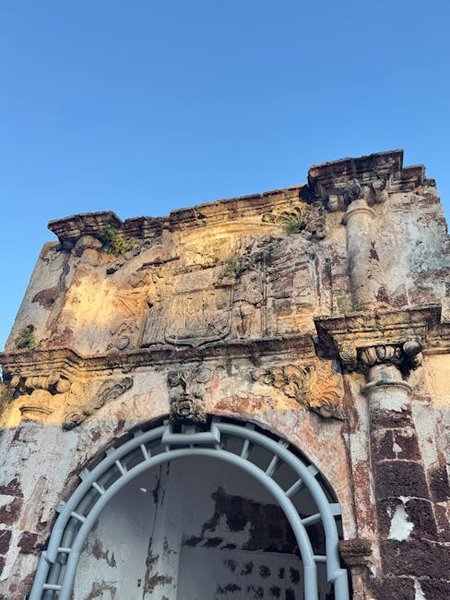
You might wonder how a ruined gate “works.” Its function today is not military, but mnemonic. It works as a memory device, a tactile anchor point for a layered past. The structure itself is a palimpsest. Look closely at the Porta de Santiago. The lower foundations are rough, grey laterite stone, quintessentially Portuguese. Above it, the smoother, red brickwork is unmistakably Dutch repair. The coat of arms carved above the arch—the Armas de Portugal—is a defiant original, a ghost of the first builders.
The fort’s original “operating system” was one of brute-force projection. Its position on St. Paul’s Hill gave it a commanding 360-degree view of the river, the port, and the strait. Cannons on its ramparts could control maritime access. Its design was a textbook example of Renaissance military architecture, meant to withstand cannon fire and repel infantry assaults. The small, heavily defended gate forced attackers into a fatal funnel. Today, that same gate funnels tourists, but the principle of a controlled passage remains.
What fascinates me technically is not the original construction, but the ongoing process of interpretation. Archaeology around the site has slowly peeled back the layers. Sections of the original walls have been unearthed and marked out in modern brick in the surrounding park, giving a sense of the fortress’s staggering original footprint. Each excavation is a puzzle piece. A shard of Ming porcelain found in the moat tells a story of trade; a Portuguese coin speaks of daily life; a cannonball fused into the rubble narrates the violence of the final siege. A Famosa works now by prompting questions, not by providing definitive answers.
A Living Classroom: Applications Beyond the Guidebook
For years, I’ve used A Famosa as a starting point for understanding broader themes. It’s my go-to case study for several real-world applications.
In Conflict Archaeology: The site is a physical archive of siege warfare. The differing construction materials tell a story of adaptation and repair under duress. Walking the marked-out perimeter, you can trace where the Dutch concentrated their bombardment in 1641. It’s a stark lesson in how military technology and tactics are literally set in stone.
In Heritage Management: A Famosa is a prime example of the challenges of preservation. It sits in a bustling, modern city, suffering from pollution, vibration from traffic, and the wear of millions of visitors. Conservation efforts here are a constant, delicate balancing act between access and preservation. The debate over whether to reconstruct more of the fort (as has been done with parts of the Stadthuys nearby) or preserve it as found is ongoing and heated among historians.
In Tourism & Narrative: This is where it gets personal. I’ve watched countless tour guides stand before the gate. Some give a two-minute spiel about the Portuguese and Raffles. The best ones, however, use it as a portal. They talk about the Malay sultanate that preceded it, the Indian and Arab merchants who built the city’s wealth, the Javanese and Chinese communities that have always been part of its fabric. They use A Famosa not as the beginning of the story, but as a violent interruption in a much longer, richer narrative. This application—using a colonial monument to tell a decolonized history—is perhaps its most powerful modern use.
The Advantages of Ambiguity (and the Disadvantages of Fame)
The greatest advantage of A Famosa is its potent ambiguity. Unlike a perfectly restored palace, it is a ruin. It requires imagination. It forces you to contemplate loss, the impermanence of power, and the layers of time. That empty archway frames not just a hill, but centuries of change. Its very incompleteness is its strength as a historical object.
Furthermore, its location is unbeatable. It’s the anchor of Melaka’s UNESCO World Heritage zone, a chronological starting point from which you can walk through Dutch squares, Peranakan mansions, and modern museums. It provides a tangible, physical connection to the earliest European chapter in Southeast Asia.
The disadvantages are equally clear. Its fame is its curse. The small site is often swamped by tour groups, making quiet contemplation difficult. It risks becoming a “checkbox” attraction—a place people snap a selfie in front of without engaging with its meaning. There’s also the inherent danger of a single narrative. For too long, Malaysian history textbooks presented 1511 as a definitive “beginning,” overshadowing the glorious 600-year history of the Melaka Sultanate. A Famosa can unintentionally perpetuate this if not contextualized properly.
Lessons from the Stone: A Personal Case Study
Several years ago, I was researching for a writing project and spent a week in Melaka, visiting A Famosa at different times of day. The dawn visits were the most revealing. With the crowds absent, the site belonged to the locals. I saw elderly men doing tai chi in its shadow, and workers cutting across the grassy mounds of the buried walls on their way to jobs in the city. It was then I realized my own initial mistake.
I had been treating A Famosa as a monument—a sealed relic of the past. These locals were treating it as a landmark—a familiar part of their present-day cityscape. This shift in perspective was profound. I began to see that its true story isn’t locked in the 1500s; it’s in how every generation since has chosen to live with it, ignore it, venerate it, or use it.
This was cemented when I interviewed a third-generation shopkeeper in the nearby kampung. He told me stories his grandfather told him: of playing in the ruins as a boy in the 1920s, when the area was still overgrown jungle and the fort was seen locally as a haunted place, not a historic one. For him, the value of its preservation wasn’t about global history; it was about preserving a touchstone of his own family’s memory in a city changing at breakneck speed. A Famosa, for him, was personal. It taught me that heritage is not just about facts and dates, but about continuous, living relationship.
Not the Only Player: Comparisons and Context
A Famosa is often the first Portuguese fort people encounter in Asia, but it’s not alone. Comparing it to other surviving structures is illuminating.
Take the Fort Jesus in Mombasa, Kenya, also built by the Portuguese (later modified by Omani Arabs). It’s a UNESCO site too, but it’s almost entirely intact—a sprawling, complete fortress you can walk through. The experience is different. Fort Jesus immerses you in the spatial reality of a 16th-century fort. A Famosa, in its fragmented state, immerses you in the idea of loss and the passage of time. One is a preserved specimen; the other is an archaeological echo.
Closer by, the Dutch Stadthuys in Melaka itself, with its vibrant red exterior and fully restored interior, offers a contrasting model. It’s a living, functional museum. The Stadthuys tells you a curated story. A Famosa asks you to invent part of the story yourself. One provides answers; the other provokes questions. Both are necessary for a holistic understanding of history.
Pitfalls to Avoid: Don’t Just See the Gate
The most common mistake visitors make is what I call the “five-minute photo op.” They see the famous gate, snap a picture, and leave. In doing so, they miss everything.
Pitfall 1: Ignoring the Landscape. Climb the steps behind the gate to the summit of St. Paul’s Hill. Stand among the ruins of St. Paul’s Church, where the body of St. Francis Xavier was temporarily interred. Look out from the same vantage point the Portuguese captains did. See how the fort, the hill, and the river mouth work together as a strategic unit. The gate alone is meaningless without this context.
Pitfall 2: Skipping the Archaeology. Walk around the base of the hill. Follow the lines of red bricks laid into the ground that trace the original walls. Seek out the excavated sections near the Melaka Sultanate Palace replica. This gives you the true scale of the fortress and turns a point of interest into a vast, imagined space.
Pitfall 3: A Eurocentric View. This is the biggest intellectual pitfall. Use A Famosa as a prompt to learn about what was there before. Visit the Baba & Nyonya Heritage Museum to understand the sophisticated Peranakan culture that evolved in the centuries after. Walk to Kampung Kling Mosque and Cheng Hoon Teng Temple to see the living continuity of the diverse communities that have always defined Melaka. A Famosa is a chapter, not the whole book.
The Future: Preservation in a Changing Climate
The future of A Famosa is precarious, but not just from the wear of tourists. Melaka is a low-lying coastal city acutely threatened by sea-level rise and increased flooding. Saltwater intrusion and extreme weather events pose a new, insidious threat to the ancient masonry that cannonballs could not destroy. Future conservation won’t just be about managing foot traffic; it will be about climate-proofing history.
I also see a future where technology will allow for more immersive, less intrusive interpretation. Imagine augmented reality apps that, when viewed through a phone, reconstruct the walls and towers around you as you stand on the hill. Not as a gimmick, but as a scholarly tool that leaves the physical ruin undisturbed while unlocking its past. The goal must be to deepen understanding without adding to the physical strain.
Furthermore, I hope the narrative continues to evolve. The excellent work at sites like the Muzium Samudera (Maritime Museum) is already placing the Portuguese arrival within a much broader context of Indian Ocean trade. A Famosa’s future lies in being increasingly woven into this richer, more complex tapestry, rather than standing as an isolated monument to a single, foreign power.
Final Thoughts: The Echo in the Archway
Today, when I stand before the Porta de Santiago, I no longer see just a relic of Portuguese empire. I see a testament to Dutch persistence, to British pragmatism (and occasional enlightenment), and to the enduring spirit of Melaka itself—a city that has absorbed, resisted, and outlasted every wave of change. The silence of the stones is deceptive. If you listen closely, with your imagination and a little historical knowledge, the echoes are deafening: the shouts of Portuguese soldiers, the prayers of Dutch merchants, the chants of British demolition crews, and the laughter of local children playing in the ruins of empires.
A Famosa’s true power lies in its unfinished story. It is a broken circle, an invitation to contemplate what was, what is, and what remains. It reminds us that the most enduring structures are not those that stay perfectly intact, but those that, even in their broken state, continue to ask us who we are and where we came from. My advice? Go see it. Touch the stone. But then, climb the hill, look out to the strait, and let the fragments in your mind build something far greater than any fortress ever was.