The 272 Steps to Enlightenment: A Journey Through Malaysia’s Batu Caves
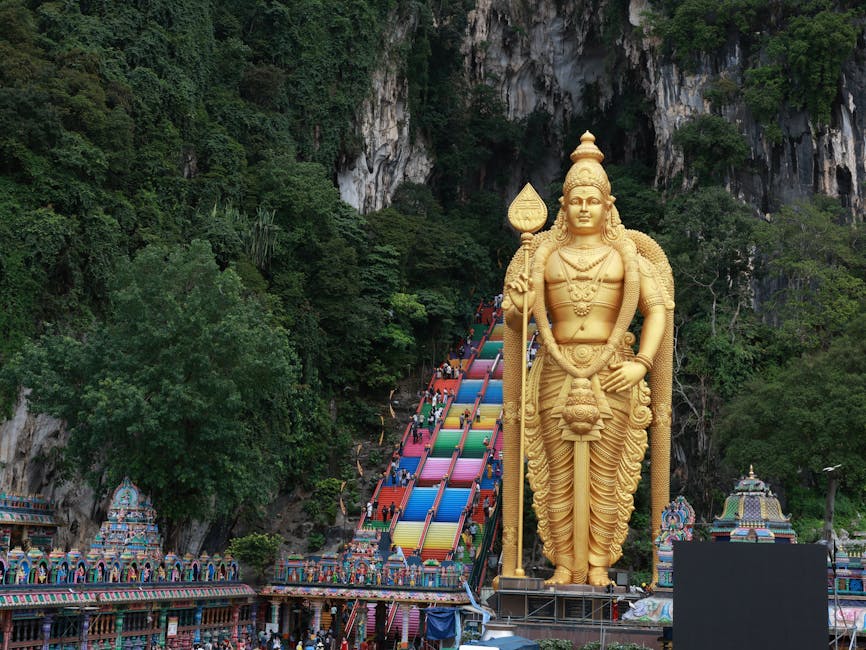
I’ll never forget the first time I saw it. It was a sweltering February morning, the air thick with humidity and the scent of frangipani. I was stuck in the infamous Kuala Lumpur traffic, a sea of red brake lights, when I glanced out the window. There, rising abruptly from the suburban sprawl of Gombak, was a colossal limestone outcrop. And at its base, a flash of brilliant gold—a towering statue—guarding a flight of steps that seemed to ascend directly into the heavens. This was my introduction to Batu Caves, a place that is far more than a tourist attraction; it’s a living, breathing epicenter of faith, geology, and cultural collision.
I’ve returned countless times since—as a curious backpacker, a festival-goer braving the crowds, and a quiet observer on a random Tuesday. Each visit peels back another layer. It’s not just a cave; it’s a lesson in patience, a test of endurance, and a profound display of devotion that has reshaped my understanding of sacred spaces.
A Cathedral Forged by Water and Time
To call Batu Caves a single “cave” is to call the Amazon a stream. It’s a complex of caverns within a 400-million-year-old limestone massif. The story begins long before humans. Rainwater, slightly acidic from absorbing carbon dioxide, seeped into cracks in the limestone (calcium carbonate). Over millennia, this gentle, persistent chemistry dissolved the rock, sculpting vast chambers, intricate pillars, and eerie, dripping formations. The main Cathedral Cave is nature’s own Gothic masterpiece, with a vaulted ceiling open to the sky, where shafts of sunlight pierce the gloom, illuminating the swirling smoke of incense.
Human history here is surprisingly recent. While local indigenous tribes likely knew of the caves, they were “officially” documented in 1878 by American naturalist William Hornaday. But the true transformation began with K. Thamboosamy Pillai, an influential Tamil trader. Inspired by the cave’s entrance, which resembled the tip of a vel (the divine spear of Lord Murugan), he consecrated a shrine here in 1891. He saw what the limestone hid: a natural, awe-inspiring temple.
The genius of this consecration lies in its synergy. The developers didn’t fight the landscape; they collaborated with it. The 42.7-meter-tall statue of Lord Murugan, painted in gleaming gold, wasn’t added until 2006, but it feels inevitable. It anchors the human element to the monumental scale of the geology. The caves were always holy; someone just had the vision to formalize it.
The Mechanics of Pilgrimage: Climbing the Rainbow Stairs
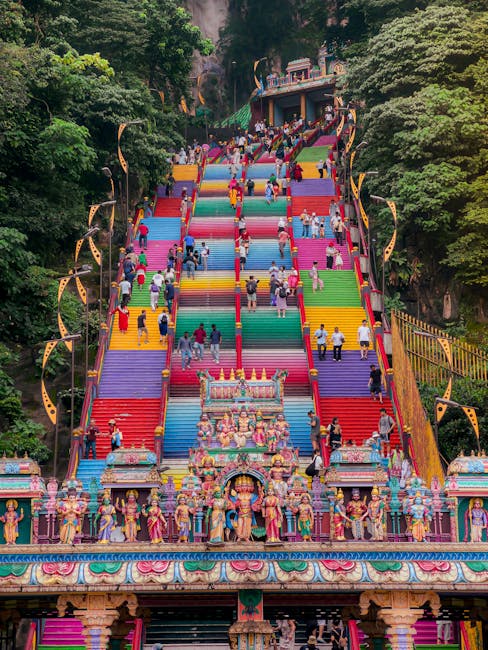
So, how does it “work”? On a practical level, visiting Batu Caves is a beautifully simple, physically demanding ritual. The central axis is the 272 concrete steps leading to the Temple Cave. But this is no ordinary staircase.

First, you must pass the court of the Macaques. These long-tailed macaques are the unofficial, mischievous gatekeepers. They’re experts in opportunism, capable of snatching a water bottle or a bag of peanuts with unsettling speed. I learned this the hard way, losing a perfectly good packet of cashews to a bold juvenile who gave me a look of pure triumph. Best practice number one: secure all loose items. Don’t carry food in your hands. Consider a bag that zips shut. They’re not malicious, but they are professional thieves.
Then, the climb. The steps, recently painted in a stunning rainbow spectrum, are deceptively challenging. The tropical heat amplifies every step. I’ve seen the full spectrum of climbers: devout elderly Hindus pulling themselves up by the railings, breathless tourists in flip-flops, and fitness enthusiasts treating it as a workout. The key is pace. The mistake is to sprint the first hundred steps. You’ll be spent by the halfway point, where a small intermediate cave offers a merciful respite. Go slow. Stop. Turn around and watch the world below shrink. Let the purpose of the journey be the journey itself.
Reaching the top is a physical and psychological release. You pass through the “mouth” of the cave into the colossal main chamber. The temperature drops instantly. The din of the city vanishes, replaced by the flutter of pigeons, the drip of water, and the low murmur of prayers. The temple complex sits within this natural auditorium, a human-scale sanctuary within a giant’s domain. The contrast is the whole point—the arduous ascent makes the serene arrival meaningful.
More Than a Temple: The Thaipusam Phenomenon
While daily worship happens here, the real-world application of Batu Caves is most spectacularly demonstrated during the Thaipusam festival. This is where theory becomes visceral, lived experience. Thaipusam is a day of penance and thanksgiving to Lord Murugan, and Batu Caves is its global stage.
I attended once, and it was an experience that recalibrated my senses. The festival is a river of humanity, devotion, and surreal physicality. Devotees, known as kavadi bearers, prepare through weeks of prayer and fasting. On the day, they enter a state of trance. Some carry simple pots of milk (paal kudam). Others undertake staggering physical ordeals: piercing their skin with hooks and spears, or bearing enormous, ornate kavadis—heavy altars anchored to their bodies by dozens of skewers.
Walking alongside them as they made their way up the 272 steps was humbling. There was no evident pain, only focused ecstasy. The air vibrated with the relentless, hypnotic beat of thavil drums and the chant of “Vel Vel!” This is the ultimate application of Batu Caves: it provides the physical and spiritual theater for an act of supreme faith. The cave isn’t just a destination; the exhausting climb is an integral part of the offering. The geography becomes the ritual.
For the non-devotee observer, it’s a masterclass in cultural respect. This isn’t a performance for tourists; it’s a deeply personal, communal act. The best practice here is to observe quietly, stay out of the way of processions, and ask permission before taking close-up photographs of individuals in prayer or penance.
The Double-Edged Sword: Blessings and Challenges
The advantages of Batu Caves are clear. It’s a powerful symbol of Malaysia’s multicultural tapestry—a vibrant Hindu heart in a Muslim-majority nation. It’s a major economic driver for the surrounding area, supporting shops, restaurants, and guides. As a natural wonder, it promotes geotourism and houses unique ecosystems, including rare cave fauna like the Trapdoor Spider.
But with great fame come significant disadvantages and pitfalls.
- Overtourism & Commercialization: On a standard weekend, it can feel less like a temple and more like a carnival. The plaza below is a maze of souvenir stalls selling cheap trinkets, often with blaring music. This commercial buzz can severely detract from the spiritual atmosphere. My mistake was first visiting on a Saturday afternoon. I felt herded. The solution? Go early. Aim to arrive right at opening time (around 7:00 AM) on a weekday. You’ll have the steps and the cave largely to yourself, with only the sincere devotees for company. The light is softer, the air is cooler, and the magic is intact.
- The Monkey Menace: I’ve mentioned them, but they warrant a warning. Beyond petty theft, they can become aggressive, especially if they see you carrying food in a plastic bag. I’ve seen them bite. This is a real pitfall for unprepared visitors. The caves provide monkey deterrent sticks, but it’s better to avoid conflict. Don’t make eye contact, don’t show fear, and just walk calmly away.
- Physical Accessibility: The 272 steps are a formidable barrier. For the elderly, disabled, or those with mobility issues, the main Temple Cave is virtually inaccessible. While there are other caves on the site with fewer steps (like the Dark Cave or Ramayana Cave), the primary experience is defined by that climb. It’s an inherent, if unfortunate, limitation of the natural site.
Beyond the Main Cave: Hidden Gems and Alternatives
Most visitors climb, snap a photo, and leave. That’s the biggest mistake of all. Batu Caves is an ecosystem. Directly to the left of the main stairs is the entrance to the Dark Cave. This is a protected conservation area, a 2km-long network of untouched chambers managed by the Malaysian Nature Society. Guided tours here are essential. You’ll trade the crowds for the quiet drip of water, and see breathtaking formations like cave curtains and flowstones, all while learning about the specialized, often blind, creatures that call this darkness home. It’s a stark, wonderful contrast to the bustling temple above.
For art and mythology, the Ramayana Cave at the foot of the hill is a revelation. You enter through the gaping mouth of a demon statue into a cave illuminated with vividly painted dioramas depicting the entire Hindu epic, the Ramayana. It’s kitsch, colorful, and utterly engaging.
When comparing Batu Caves to other sacred cave sites, like the Elephanta Caves near Mumbai or the Dambulla Cave Temple in Sri Lanka, its uniqueness is in its raw, unadorned scale and its role in an active, massive festival. Elephanta has more ancient, sculptural art. Dambulla is a series of beautifully painted Buddha-filled grottoes. But Batu is a working, breathing, climbing temple. The pilgrimage is athletic, immediate, and shared with monkeys and millions.
The Future: Preservation vs. Progress
The future of Batu Caves hangs in a delicate balance. The recent painting of the steps in rainbow colors, while initially controversial, has become a beloved symbol of unity and joy. But further development is a tightrope walk.
There’s constant pressure to add more facilities—escalators, larger shopping complexes, brighter lights. While improving accessibility is a noble goal, the risk is sanitizing the experience. The hardship of the climb is pedagogic. Making it too easy could sever the vital link between effort and spiritual reward that defines the place.
The greater challenge is environmental. The sheer volume of visitors stresses the limestone structure and its delicate ecosystems. Managing waste, controlling the monkey population humanely, and protecting the Dark Cave’s ecology are ongoing battles. The future must be one of sustainable pilgrimage, where visitor numbers are managed not just for comfort, but for preservation.
The Final Ascent
Batu Caves taught me that a sacred space doesn’t have to be quiet to be profound. Its power is in its chaos, its contrasts—the serene and the chaotic, the ancient rock and the fresh coat of paint, the solemn prayer and the chattering monkey.
My final piece of advice isn’t about what to bring or when to go. It’s about mindset. When you climb those rainbow steps, don’t just race to the top. Feel the burn in your thighs. Watch the faces of the pilgrims around you—the determination, the exhaustion, the joy. At the top, find a quiet spot against the cool limestone wall. Don’t just look at the shrine; look out from the cave mouth. See the sprawling city in the distance, the world you just ascended from. In that moment, you’ll understand. Batu Caves isn’t an escape from the world. It’s a vantage point from which to see it more clearly, having earned the view with every single one of those 272 steps.