The Heartbeat of Kuala Lumpur: A Love Letter to Petaling Street
I remember the first time I truly felt Petaling Street. It wasn’t my first visit—I’d been a tourist shuffling through its covered walkway years before, snapping photos of the red lanterns and dodging hawkers. No, the moment it clicked was on a sweltering Tuesday afternoon, well after the lunch rush had faded. I was hunting for a specific, near-impossible-to-find spare part for a vintage camera. A shopkeeper, seeing my futile search, didn’t just shake his head. He took my piece, squinted at it, and said, “Wait here.” Ten minutes later, he returned, not with the part, but with a scrap of paper bearing a name, “Ah Meng,” and directions to a tiny stall three alleys over, tucked behind a fabric wholesaler. That’s Petaling Street. It’s not just a place; it’s a living, breathing network—a chaotic, glorious ecosystem where everything is connected if you know how to look.
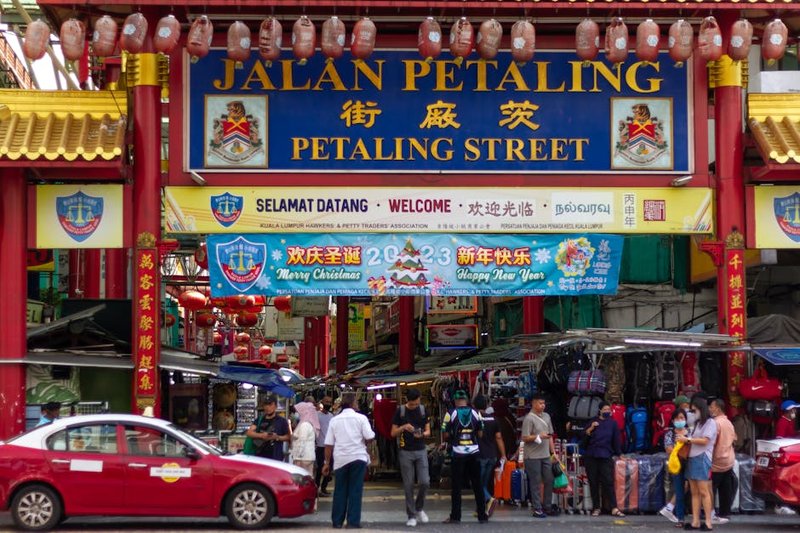
This is KL’s original downtown, the nucleus from which the modern metropolis exploded. To walk Petaling Street is to time-travel with every step. One moment you’re beneath the iconic green-tiled, arched gateway, surrounded by the 21st-century cacophony of selfie sticks and influencer poses. The next, you duck into a pre-war shophouse, its walls stained with decades of humidity and history, and you’re in 1920s Malaya.
From Tin Mines to Tourist Mecca: The Layers of History
Petaling Street’s story is the story of Kuala Lumpur itself. It began in the mid-19th century as a muddy track servicing the tin mines upriver. As Chinese miners (predominantly Hakka and Cantonese) flocked to the area, they built shophouses—the classic two or three-story structures where business was done on the ground floor and the family lived above. This became the heart of Chinatown, a self-sufficient enclave where clan associations held sway, opera houses thrived, and the community’s pulse was strongest.
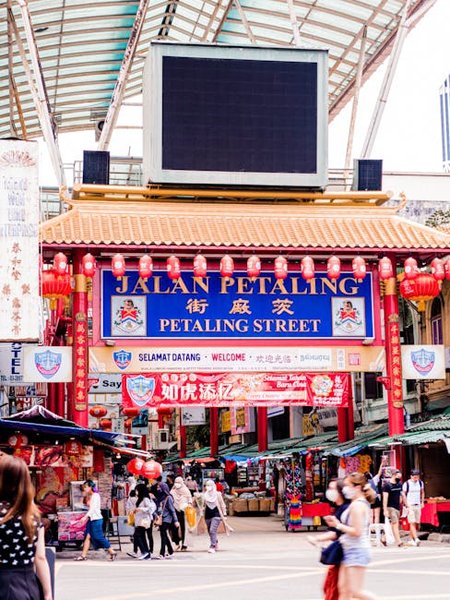
You can still read this history in the architecture if you look past the souvenir t-shirts. Look up. Above the neon signs for foot massages and durian puffs, you’ll see intricate plasterwork, faded Peranakan-style tiles, and ornate wooden shutters. The Sri Maha Mariamman Temple, KL’s oldest Hindu temple, sits just at the edge of the street’s fray—a testament to the area’s layered, multicultural fabric from the very beginning. The street survived the Japanese Occupation, witnessed the tumult of Independence, and evolved through each economic boom and bust. The iconic green archway and covered walkway, installed in the early 2000s, were an attempt to beautify and control the chaos. In many ways, they succeeded in creating the postcard image. But the real Petaling Street has always refused to be fully tamed; it spills out from under that cover in every direction.
How It Really Works: The Unwritten Rules of the Bazaar
On paper, Petaling Street is a tourist market selling bags, watches, and souvenirs. In reality, it operates on a complex, unwritten code of social commerce and razor-sharp entrepreneurship. It’s a masterclass in fluid adaptation.
The day has distinct acts. Mornings belong to the old-timers. This is when you’ll find the traditional businesses—the herbalists weighing out ginseng root, the calligraphers mixing ink, the coffee shops (kopitiams) filled with retirees reading newspapers over thick kopi-o. The pace is slow, conversational. By midday, the gears shift. The stallholders for the covered market begin their setup, rolling out their tables with practiced efficiency. The air fills with the clatter of rolling shutters and the first calls of “Hello, look only, no problem!”
Then comes the main event: the bargaining ballet. This is where most first-timers falter. The initial price quoted is a starting point for a ritual, not a statement of value. The key isn’t aggression, but engagement. A smile, a bit of humor, a show of genuine interest goes much further than a scowl. I learned this after a disastrous early attempt where I haggled a vendor down on a cheap trinket only to realize I’d made the interaction transactional and sour. The goal isn’t just to “win” on price; it’s to reach a mutually agreeable close, often sealed with a handshake and a “Thank you, boss!”
The ecosystem extends deep into the surrounding grid of alleys and parallel streets. Jalan Hang Lekir and Jalan Sultan are its vital organs. Here, you transition from generic souvenirs to specialized trades: wholesale fabric, custom-made shoes, traditional wedding attire, and electrical components. This is the real marketplace for locals. The covered street is the glittering facade; these side lanes are the working engine room.
More Than Knock-Offs: The Street’s Authentic Applications
Dismissing Petaling Street as just a fake goods market is a profound misunderstanding. Its applications are as diverse as its visitors.
- A Culinary Pilgrimage: This is, first and foremost, a food paradise. It’s where you’ll find legendary establishments that define Malaysian cuisine. Kim Soya Bean serves silken tofu pudding (tau fu fa) so delicate it seems to evaporate on your tongue. The Hokkien mee at Kim Lian Kee, stir-fried over a roaring fire in a decades-old blackened wok, is a benchmark for the dish. These aren’t restaurants; they’re institutions. The street food stalls that appear at dusk offer a different kind of magic—char kuey teow with that elusive wok hei (breath of the wok), succulent satay, and refreshing cendol. It’s a living, edible museum.
- A Sourcing Hub for the Savvy: For small business owners, artists, and restaurateurs, the side lanes are a treasure trove. I know a boutique hotel owner who sources all her custom lampshades from a tiny shop on Jalan Sultan. A local craft brewer found unique ceramic tap handles here. It’s a place for volume, for the unusual, for things you didn’t know you needed until you saw them.
- A Cultural Nerve Center: During major festivals like Chinese New Year or Mid-Autumn Festival, Petaling Street transforms into a river of red and gold. It’s the central marketplace for traditional goods—lanterns, mooncakes, decorations, and specific fruits and sweets for offerings. The energy is electrifying, a communal preparation for celebration. The Guan Di Temple in the middle of it all becomes a focal point of incense and prayer.
The Yin and Yang: What You Gain and What You Grapple With
The advantages of Petaling Street are visceral. It offers unmatched density and variety. In a three-block radius, you can eat a world-class meal, get a suit tailored, buy antique jade, and find a phone charger, all while absorbing a century of history. It’s authentically chaotic. In a world of sanitized malls, it’s refreshingly, sometimes frustratingly, real. It’s a people-watching epicenter, where the tapestry of Malaysian society—and global tourism—is on full display.
But the disadvantages are part of the package. The relentless hustle can be exhausting. The constant calls from stallholders, while part of the atmosphere, can feel oppressive if you’re not in the mood. Product authenticity is, of course, a minefield. You are not buying a genuine Rolex for RM150. The savvy approach is to buy for the aesthetic or function, not the brand illusion. Crowds and heat are a given; visiting at peak hours is a test of endurance. And there’s a valid conversation about preservation vs. progress. As property values soar, how many of the traditional family businesses can hold on against rising rents and the lure of selling to another chain pharmacy or bubble tea franchise?
Case Study: The Watch Repairman of Lorong Panggung
My most poignant Petaling Street experience involves a man named Mr. Tan. His “shop” is a wooden kiosk, no bigger than a phone booth, tucked in a forgotten alley off Lorong Panggung. It’s stacked with hundreds of tiny drawers containing every watch movement, crystal, and hand imaginable from the 1940s onward. I brought him a broken 1970s Seiko—a sentimental piece. He examined it with a jeweler’s loupe, grunted, and said, “One week. Come back Thursday afternoon.”
When I returned, he had not only fixed it but had polished the case and found a period-correct bracelet. The cost was absurdly low. As he worked, he told me his father started the stall after the war, and he’d taken it over. “Young people, they don’t want this,” he said, gesturing to his magnifying lamp. “They throw away, buy new smartwatch.” His kiosk is a museum of mechanical time, a repository of skills fading from the world. He represents the soul of old Petaling Street: deep specialization, honest work, and a tangible connection to history. Finding him wasn’t on any map; it was a gift from the street itself.
The Mall vs. The Market: A Stark Comparison
Contrast Petaling Street with a place like the nearby Bukit Bintang malls (Pavilion, Starhill Gallery). The comparison is stark. The malls offer climate-controlled comfort, guaranteed authenticity, fixed prices, and a curated, predictable experience. They are clean, efficient, and safe.
Petaling Street offers none of those guarantees. What it offers instead is discovery, negotiation, and sensory immersion. In a mall, you are a consumer. On Petaling Street, you are a participant. One is a transaction; the other is an interaction. You don’t go to Petaling Street for efficiency. You go for the possibility—the chance find, the unexpected conversation, the perfect bowl of noodles you’ll dream about for years.
Common Pitfalls and How to Sidestep Them
- Paying the “Tourist Tax”: The first price is always inflated. Do a lap, get a sense of things. If a stall has fixed prices (some do, for simplicity), it’s usually posted. Otherwise, be ready to bargain politely but firmly. A good rule is to start at 40-50% of the asking price and meet somewhere in the middle.
- Getting “Item Swapped”: Be vigilant when buying electronics or higher-value items. I’ve seen people agree on a phone model, pay, and have the vendor slip a different (older, cheaper) unit into the box during packaging. Always inspect the exact item you’re buying before money changes hands.
- Missing the Real Gems by Staying Under the Cover: The biggest mistake is never leaving the covered walkway. Your experience will be 80% generic. Venture into the side lanes and perpendicular streets. That’s where the character lives.
- Going at the Worst Time: Weekends and evenings are a human logjam. For a more pleasant, exploratory experience, go on a weekday morning. You’ll see the street waking up, and shopkeepers will have more time to talk.
- Ignoring the Food: If you only shop and don’t eat, you’ve missed 70% of the point. Come hungry. Follow the queues of locals—they always know best.
The Future: A Precarious Balancing Act
The future of Petaling Street hangs in a delicate balance. Gentrification is creeping in from all sides. Chic cafes and hostels are renovating old shophouses, which is a double-edged sword—it preserves the building shell but often replaces the original business with something catering to a wealthier, often foreign, crowd.
The challenge for Kuala Lumpur is to manage this evolution without sanitizing the street’s essential character. Can Mr. Tan’s watch repair kiosk survive next to a craft cocktail bar? Can the century-old herbalist compete with a trendy juice cleanse outlet? The street has always adapted, but this current wave of change feels different, faster, and potentially more homogenizing.
The hope lies in a growing appreciation for heritage and authenticity. There’s a movement among younger Malaysians to value these traditional trades and spaces. Perhaps the future is a hybrid—a street where the old and new coexist not as adversaries, but as complementary layers, much like the street’s own history.
Final Thoughts: An Unbreakable Rhythm
Petaling Street is not for everyone. It’s loud, it’s messy, it demands your attention and your street smarts. But for those willing to engage with it on its own terms, it offers something no mall or planned district ever can: a direct, unfiltered connection to the heart of a city.
It taught me that the best travel experiences aren’t about comfort or convenience; they’re about connection and context. It taught me to look beyond the obvious, to appreciate the beauty in organized chaos, and to understand that value isn’t always about a price tag—sometimes, it’s about the story you get with the purchase.
The red lanterns will keep glowing, the hawkers will keep calling, and the woks will keep firing. The rhythm of Petaling Street, forged in the tin rush and tempered by time, is unbreakable. It’s the relentless, beautiful heartbeat of Kuala Lumpur, and as long as it keeps beating, the soul of the city is alive and well. Your job is just to step in and feel its pulse.