The Blue Umbrella and the Concrete Lotus: Finding the Soul of Malaysia’s National Mosque
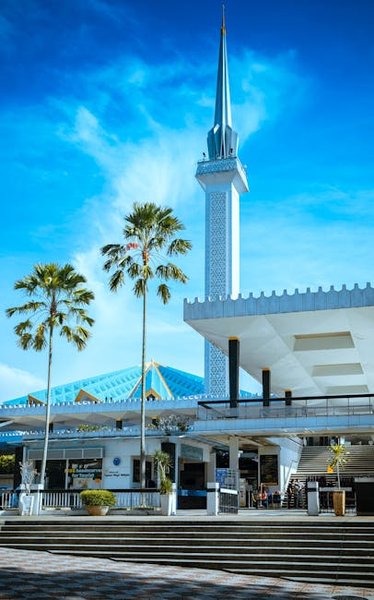
I remember the first time I saw it, not in a glossy travel brochure, but from the window of a rattling, non-air-conditioned bus caught in Kuala Lumpur’s infamous afternoon traffic. The sun was a merciless orb, the humidity a physical weight, and the cityscape a dense jungle of glass and steel. Then, through the haze, it emerged: a structure so audaciously modern, so defiantly geometric against the tropical sky, that it seemed to have landed from another world. A vast, pleated blue roof, folded like a half-open umbrella, sheltering a serene, minimalist complex. This was the Masjid Negara, the National Mosque of Malaysia. My initial reaction, I’m embarrassed to admit, was one of architectural curiosity, not spiritual awe. It looked more like a spaceship or a grand civic centre than my preconceived notion of a mosque, shaped by the domes of Istanbul or the courtyards of Isfahan.
That disconnect, I later learned, was precisely the point. My journey with the National Mosque didn’t begin with a prayer, but with a question: Why does it look like that? Over countless visits, conversations with its caretakers, and quiet moments spent in its shaded courtyards, that question opened a door to understanding not just a building, but the soul of a young, ambitious nation finding its voice. This isn’t just a place of worship; it’s a manifesto in concrete and marble, a bold statement of post-colonial identity, and a living, breathing social hub that has taught me more about Malaysia than any history book ever could.
A Nation’s Prayer in Reinforced Concrete: The Historical Context
To grasp the National Mosque’s significance, you have to wind the clock back to the late 1950s. The Federation of Malaya had just gained independence from British rule in 1957. This was a nation in the urgent, exhilarating throes of self-invention. The question of identity was paramount. What would a modern, progressive, multi-ethnic Muslim-majority nation look like? The symbols of the past—the colonial administration buildings, the Sultanate palaces—were either inherited or regional. The country needed a new, unifying national symbol that reflected its aspirations.
The commission for the National Mosque, initiated by the first Prime Minister, Tunku Abdul Rahman, was a direct answer to that need. Completed in 1965, it was a conscious departure from the ubiquitous Moorish or Middle Eastern architectural styles often imposed by colonial powers elsewhere. The design team, a trio of Malaysian architects (Baharuddin Abu Kassim, Hisham Albakri, and Lim Chong Keat), alongside British architect Howard Ashley, made a radical choice. They looked not to the past, but to the future. They embraced Modernism, the architectural language of progress and innovation sweeping the globe.
The symbolism is layered and brilliant. The main prayer hall’s roof isn’t a dome; it’s a 16-pointed star concrete folded plate structure, representing the 13 states of Malaysia and the three federal territories (at the time of construction, it was a 9-point star for the 11 states, later conceptually adapted). This “blue umbrella” (payung), a common item shielding from both sun and rain in the tropics, is reimagined on a monumental scale. It’s shelter, protection, and unity, all expressed through cutting-edge engineering. The 73-meter-high minaret, shaped like a closed umbrella, reinforces this theme. Instead of intricate tilework or calligraphy, the ornamentation is in the form—the geometric patterns cast by the sun through concrete mashrabiya (perforated screens), the play of light and shadow on raw concrete surfaces. This was Malaysia declaring it could be both devoutly Islamic and confidently modern, synthesizing faith with a forward-looking, technological identity.
How It Works: More Than a Building, An Ecosystem
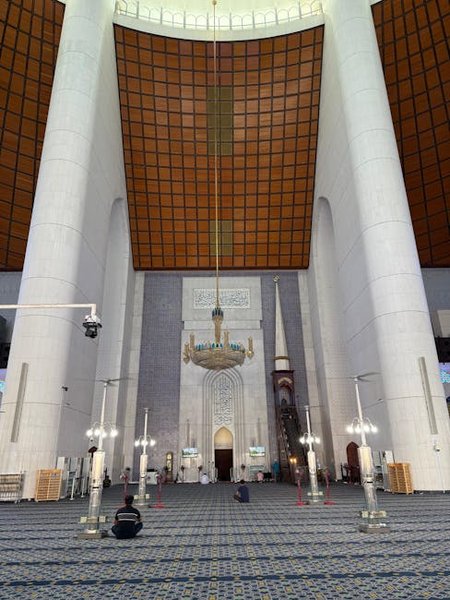
On a purely functional level, the mosque is a masterclass in tropical modernist design, a lesson I’ve come to appreciate deeply. Its workings are a direct response to the climate. The vast, overhanging roof provides deep shade, keeping the walls and interior cool. The open-sided corridors and courtyards, like the beautiful Sahn (main courtyard) with its reflecting pools and fountains, promote constant cross-ventilation. Walking from the scorching KL heat into the colonnaded walkways is like stepping into a cool, stone forest. The sound of trickling water from the fountains isn’t just decorative; it provides a psychological cooling effect and masks the city’s noise, creating an auditory oasis.
The spatial organization is equally thoughtful. The complex is divided into zones of increasing sanctity. The outer grounds are public parkland, where tourists and locals mingle. The main courtyard is a transitional, contemplative space. The prayer hall itself is the serene, carpeted heart. But what truly makes it “work” is its ancillary functions. It houses a mausoleum for national heroes, a library, a lecture hall, and administrative offices. It’s designed not just for the five daily prayers, but for community life: weddings, religious classes, interfaith dialogues, and disaster relief coordination. During my visits, I’ve seen it function as all these things—a quiet space for a student to read, a gathering point for a charity drive, and of course, the powerful, collective rhythm of Friday prayers, where the vast hall and courtyards fill with a silent, unified congregation that is a breathtaking sight.
Applications in the Real World: A Living Social Fabric
The National Mosque’s most profound application is as a social condenser. In a rapidly modernizing, sometimes impersonal city, it provides an anchor. I recall a poignant case study from a conversation with one of the mosque’s volunteer guides, Pak Ali. He described the floods that hit parts of KL in the early 2000s. The mosque’s large, sheltered spaces and kitchens were immediately converted into a primary relief centre. It wasn’t just a place for Muslims; it became a community hub where people of all backgrounds came to donate supplies, volunteer, and seek aid. Its central location and symbolic stature made it the natural, trusted focal point for civic action.
Furthermore, it serves as Malaysia’s de facto diplomatic front door for the Muslim world. Visiting dignitaries, from kings to presidents, are often brought here. It’s the country’s handshake with the global Ummah, saying, “This is our interpretation, our contribution to Islamic civilization.” For the average Malaysian, especially those from rural areas visiting the capital, a trip to the National Mosque is a rite of passage. I’ve watched families, dressed in their finest, take countless photos by the reflecting pool, their pride palpable. It’s a tangible connection to their national identity.
Advantages, Disadvantages, and the Friction of Time
The mosque’s advantages are its boldness, its climate responsiveness, and its powerful symbolism as a unifying, modern icon. It successfully broke the mold and created a uniquely Malaysian architectural vocabulary for Islamic structures, influencing mosque design across the country.
However, time has revealed some disadvantages, or perhaps, points of friction. The raw concrete (brutalist) aesthetic, so revolutionary in the 60s, can feel stark and imposing to some. It lacks the intimate, ornate warmth of older wooden masjids. The scale is vast, which can feel impersonal compared to a neighbourhood surau. There’s also the inevitable tension between its role as a national monument/tourist attraction and its primary function as a house of worship. I’ve witnessed the occasional awkward moment where tourists, unaware of prayer times or dress codes, inadvertently intrude on the solemnity of prayer. Managing this dual identity is an ongoing, delicate balancing act for its administrators.
A Personal Anecdote: The Lesson of the Afternoon Rain
My most enduring lesson from the National Mosque came from a mistake I didn’t even know I was making. On an early visit, I was meticulously photographing the architectural details—the angles of the roof, the patterns of the screens. I was treating it as a museum piece. A sudden, torrential tropical downpour sent everyone scurrying under the deep eaves. I found myself packed next to a group of elderly Malaysian men. As we watched the rain sheet down, one of them, noticing my camera, pointed to the cascading water from the roof’s unique folds.
“You see,” he said in halting English, smiling. “The architect was clever. The roof, it is like a payung. But see how the water falls? Not in one flood, but in many channels. Like our country. Many people, one shelter. The water goes to the garden, to the pools. Nothing is wasted. It is all used.”
In that moment, my perspective shifted entirely. I was no longer looking at an abstract geometric form. I was seeing a philosophy. The building wasn’t just expressing an idea; it was performing it. It was managing the rain, channeling it, making it useful. It was a perfect metaphor for the nation’s aspiration: to take the diverse streams of its population and channel them into a nourishing whole. I stopped seeing just concrete and started seeing intention.
Comparison with Alternatives: The Sultan Salahuddin Mosque
Inevitably, the National Mosque is compared to Malaysia’s other iconic mosque, the Sultan Salahuddin Abdul Aziz Shah Mosque in Shah Alam, completed in 1988. Known as the “Blue Mosque” for its stunning blue-tiled dome (the world’s largest at the time), it represents a different architectural and philosophical choice.
While the National Mosque is modernist and minimalist, the Shah Alam mosque is a triumphant return to a grand, classical Ottoman style, albeit executed with modern materials and scale. It’s spectacular, awe-inspiring, and deliberately connects Malaysia to a broader, historical Islamic architectural heritage. The comparison is fascinating. The National Mosque says, “We are new, we are modern, we are ourselves.” The Shah Alam mosque says, “We are part of a great, global Islamic civilization.” They are two sides of the same national coin—one looking forward, one respectfully acknowledging the past. The National Mosque feels like a thoughtful argument; the Shah Alam mosque feels like a majestic declaration.
Common Pitfalls and How to Engage with It
For visitors, the main pitfall is treating the National Mosque as a mere photo stop. To avoid this:
- Time your visit: Go outside of the five daily prayer times (especially the midday Friday prayer) for uninterrupted viewing, but try to be present during the call to prayer (Azan). Hearing it echo through the concrete geometries is an unforgettable experience.
- Observe the details: Don’t just look up at the big roof. Sit in the courtyard. Watch the light move. Feel the breeze channeled through the corridors. See how people use the space.
- Engage respectfully: Dress modestly (robes are provided if needed). Speak softly. If prayers are on, observe from the back or the sides. Remember it’s a living, breathing community centre, not a silent museum.
- Look beyond the main hall: Explore the peaceful Mausoleum of Malaysian Patriots and the landscaped gardens. The story is in the entire complex.
The Future Outlook: Preservation and Evolution
The National Mosque now faces the challenge of middle age. How does a “modern” icon from the 1960s stay relevant? Conservation is key. The original concrete needs careful, sensitive maintenance to preserve its integrity without losing its character. There’s also an evolving role. In an increasingly digital and sometimes polarized world, its function as a physical space for community gathering and interfaith understanding is more vital than ever. I believe its future lies in deepening its role as a centre for dialogue and education, continuing to bridge its symbolic national role with hyper-local community needs. It must remain, as it was always intended to be, both a shelter and a beacon.
Wrapping up, the National Mosque of Malaysia taught me that architecture at its best is not just about form or function, but about narrative. It’s a story poured in concrete. It’s the story of a young nation daring to imagine its future, choosing a bold, unconventional path to express an ancient faith. It isn’t trying to be the most beautiful or the most ornate mosque in the world. It’s trying to be the most Malaysian. From that traffic-jammed bus window to standing in its quiet courtyard during a rainstorm, my understanding evolved from seeing a curious building to feeling the pulse of a nation’s ambition. It remains, for me, one of the most honest and compelling pieces of nation-building ever constructed—a blue umbrella for the soul of a country, forever open to the sky.