The Skybridge and the Soul: What the Petronas Towers Taught Me About Ambition
I remember the first time I saw them, not from a postcard or a travel brochure, but from the backseat of a taxi crawling through Kuala Lumpur’s evening traffic. It was 2005, and I was a young architect, wide-eyed and fresh off a project in Europe, thinking I understood something about scale. Then, the towers appeared. They didn’t just rise; they emerged, a pair of geometric, crystalline giants piercing the equatorial haze. The light was that soft, golden hour glow, and the stainless-steel cladding didn’t just reflect the sunset—it seemed to absorb it and radiate a warmth of its own. In that moment, any clinical, textbook understanding of “tallest buildings” evaporated. The Petronas Twin Towers weren’t just a feat of engineering; they were a statement of identity. And over the years, through multiple visits, professional study, and countless conversations with those who work in their shadow, I’ve come to see them as one of the most profound architectural dialogues of the late 20th century.

From Oil Wells to Skyline: A Nation’s Aspiration Cast in Steel
To understand the towers, you must first understand the Malaysia of the 1990s. This wasn’t a legacy project for a centuries-old global power; it was a declaration from a rapidly developing nation. The client was Petronas, the state-owned oil and gas company, and the mandate was symbolic: create an icon for a modern, confident, technologically-advanced Malaysia. The choice of architect, the Argentine-American Pritzker laureate César Pelli, was itself a masterstroke. Pelli didn’t impose a Western glass box. Instead, he delved into Islamic art, the dominant cultural force in Malaysia, and found his primary motif: geometric patterns based on squares and circles.
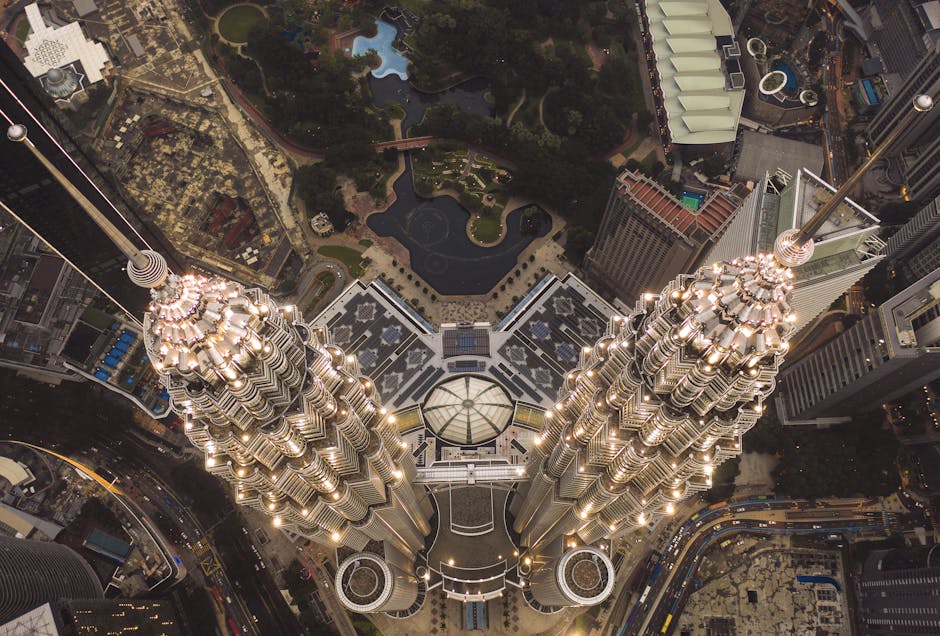
The resulting floor plan is a simple, elegant “circle of squares” with semicircular protrusions. This isn’t just aesthetic; it’s deeply functional, providing column-free office space and incredible stability. But the genius is in the translation to the sky. As the towers ascend, the squares rotate, creating the iconic, tapering profile that suggests a bundle of minarets or a stylized eight-pointed star. It’s a modern skyscraper that speaks an ancient visual language. I’ve spent hours sketching the façade from the KLCC Park below, and the way the sun plays across the multifaceted surface, creating shifting patterns of light and shadow, is endlessly captivating. It feels alive, responsive to its environment in a way that a sheer glass cliff-face never could.
The Dance of Two Giants: How They Actually Stand Up
The technical narrative of the Petronas Towers is a thriller of one-upmanship and ingenious problem-solving. For a brief period from 1998 to 2004, they held the official title of world’s tallest buildings. But here’s the fascinating nuance: height can be measured in different ways. The Petronas Towers’ spires are structural, integral to the design, pushing their pinnacle height to 451.9 meters. Competitors like the Sears (now Willis) Tower in Chicago have taller occupied floors, but their antennas are add-ons. This sparked a global debate that led to the Council on Tall Buildings and Urban Habitat defining four categories of height. The Petronas Towers’ claim was based on the highest architectural element, a rule they helped write.
But the real magic lies beneath and between them. Kuala Lumpur sits on what engineers politely call “difficult” ground—a deep layer of soft limestone and silt. Building the world’s tallest towers here was like trying to erect a giant on a sponge cake. The solution was the world’s deepest foundations at the time: a massive concrete “mat” over 4 meters thick, supported by 104 friction piles bored up to 120 meters into the earth. It’s a hidden, inverted mountain holding everything up.
Then there’s the Skybridge. 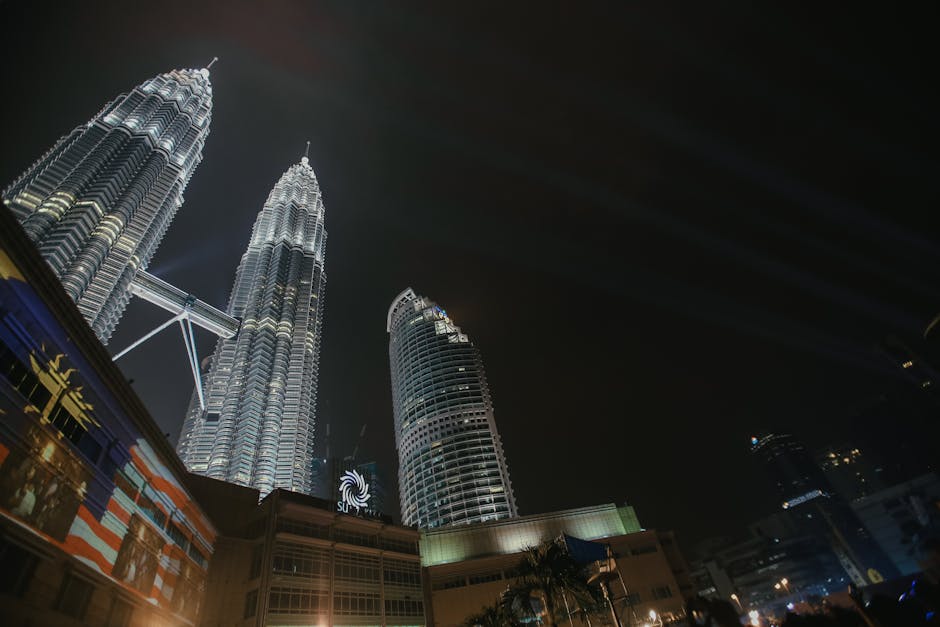 To many, it’s the Towers’ most iconic feature. It’s not just a viewing platform; it’s a two-story, fully functional structural bridge that connects the towers at the 41st and 42nd floors. And it’s not fixed. In high winds or seismic activity, it’s designed to slide in and out, allowing the towers to sway independently. I’ve been on it during a passing storm, and feeling that slight, engineered movement is a humbling reminder that these static-seeming giants are in a constant, silent dance with the forces of nature. It’s a masterpiece of tuned mass dampers and flexible joints, a lesson in resilience over rigidity.
More Than an Office: The Ecosystem in the Sky
The common mistake is to see the Petronas Towers as just two office buildings. They are the kinetic heart of the 100-acre KLCC development, a master-planned city within a city. This is where their application in real-world urban design shines. The towers house Petronas and a host of other blue-chip companies, but below them lies the Suria KLCC mall, a six-level retail paradise. Beneath that, a concert hall and the superb Petrosains science museum. Outside, the 50-acre KLCC Park, designed by Roberto Burle Marx, provides the essential “lung”—a manicured green space with a symphony lake and children’s pool that softens the hard urban edges.
This vertical integration is their true success. You can live, work, shop, learn, and relax without ever leaving the complex. It created a new gravitational center for Kuala Lumpur, pulling business and prestige away from the old colonial core. I’ve watched families picnic in the park with the towers looming above, teenagers skateboarding in their shadow, and office workers spilling out for lunchtime runs. They are not an aloof monument; they are woven into the daily fabric of the city. This holistic approach to a skyscraper’s purpose is a best practice in modern urban development that many later projects have tried, and often failed, to emulate.
The Double-Edged Sword: Advantages and Inevitable Trade-Offs
The advantages of the Petronas Towers are monumental, both literally and figuratively.
- National Iconography: They succeeded spectacularly in putting Malaysia on the global map. They are an instant, recognizable symbol of ambition and cultural pride.
- Engineering Benchmark: They pushed the boundaries of high-rise construction on unstable ground, revolutionizing foundation techniques in the region.
- Urban Regeneration: The KLCC development transformed a former racecourse into Kuala Lumpur’s premier economic and leisure district, boosting property values and tourism immeasurably.
- Cultural Synthesis: The design elegantly bridges Islamic heritage and postmodern technology, proving that skyscrapers need not be culturally anonymous.
But such ambition comes with costs and compromises.
- The Price of Prestige: The construction cost was staggering—estimated at over US$1.6 billion in the 1990s. The economic rationale was always more about national branding than pure real estate ROI.
- Operational Beast: The energy consumption to cool and maintain 88 floors of glass and steel in a tropical climate is astronomical. While efforts have been made to improve efficiency, they remain symbols of intensive resource use.
- The “Icon” Trap: Some critics argue that such megaprojects can divert attention and funds from broader, less glamorous urban infrastructure needs. They create a “postcard city” that can sometimes feel disconnected from its own hinterlands.
- Accessibility: While public areas exist, the towers themselves are exclusive. Getting up to the Skybridge or the observation deck requires tickets and planning, separating the icon from the people who live around it—a common pitfall of landmark skyscrapers.
A Personal Lesson in Scale and Humanity
My most poignant memory isn’t from the observation deck. It was during a research trip, interviewing a senior facilities manager who had worked there since the towers opened. We were in a back-of-house corridor, surrounded by the hum of servers and HVAC systems. He showed me the service elevators, the dedicated freight bays, the army of technicians, cleaners, and security staff that keep the dream alive 24/7. “Everyone sees the sparkle,” he said, gesturing upwards. “I see the sweat.” It was a grounding moment. We fetishize the architect and the engineer, but a building of this scale is a living organism sustained by thousands of unseen hands.
Another lesson came from simply observing the crowds. At the base, especially on weekends, you see a microcosm of Malaysia and the world: tourists in awe, local couples on dates, migrant workers taking their day off to marvel at the symbol of their host country’s wealth. The towers act as a great equalizer in that shared moment of looking up. Yet, the security perimeter, the bag checks, the ticket barriers to ascend, create an invisible line. It taught me that the true test of a public icon isn’t just how it looks on the skyline, but how it feels at the ground level. Does it welcome or intimidate? The Petronas Towers, for all their beauty, walk that tightrope every day.
Not the Only Way to the Sky: Comparisons and Context
In the global “height race,” the Petronas Towers are often compared to their successors: Taipei 101, the Burj Khalifa, the Shanghai Tower. Each represents a different philosophy. Taipei 101 is a rigid, pagoda-inspired giant built in a seismic zone, its tuned mass damper a tourist attraction in itself. The Burj Khalifa is a sheer, vertical thrust, a desert flower of unimaginable height that makes the Petronas Towers look almost intimate by comparison. The Shanghai Tower uses a twisting, double-skin form to combat typhoon-force winds.
The Petronas Towers’ uniqueness lies in their duality. They are a pair, a conversation. They don’t seek to be the solitary, supreme pinnacle. Their strength is in their relationship to each other and to the city grid. Where the Burj Khalifa stands alone in a vast new downtown, the Petronas Towers are integrated into a dense, walkable, mixed-use neighborhood. Compared to the older, more utilitarian skyscrapers of New York or Chicago, they are far more culturally specific and symbolically loaded. They showed that a skyscraper could tell a story beyond corporate power.
Pitfalls for the Next Generation of Icons
Studying the lifecycle of the Petronas Towers offers clear warnings for future megaprojects:
- Don’t Neglect the Pedestrian Experience: The grandeur can overwhelm. Successful plazas and parks at the base are non-negotiable to humanize the scale.
- Plan for Day 100, Not Just Day 1: The staggering operational and maintenance costs must be financially sustainable for decades, not just covered by the initial development budget.
- Beware of Symbolic Overreach: A building can become a target, both physically and politically. Its symbolic weight must be managed with cultural sensitivity and security integrated gracefully, not as an afterthought.
- Integrate, Don’t Isolate: The towers work because of KLCC. A standalone trophy tower in a disconnected area often becomes a white elephant.
The Future: Guardians of a Maturing Skyline
Kuala Lumpur’s skyline has exploded since the twins were completed. They are no longer the solitary giants, but they have matured into something perhaps more valuable: the guardians of the city’s center, the established, elegant elders in a forest of newer, sometimes flashier, towers. Their future is one of stewardship. Ongoing retrofits to improve energy efficiency are crucial. Their role as a cultural site will only grow as they transition from “the newest” to “the classic.”
The next challenge is digital integration. Can these 1990s marvels adapt to the smart-building era of IoT sensors, AI-driven energy management, and changing workplace patterns? I believe they can, precisely because their underlying design—both technical and philosophical—was so robust. They were built not just for an era, but with a vision of permanence and adaptability.
Standing in KLCC Park today, watching the nightly light show play across their facades, I see more than steel and glass. I see the audacity of a nation’s dream, the elegance of a geometric principle stretched to the clouds, and the daily reality of the city that has grown up in their embrace. The Petronas Twin Towers taught me that the greatest architecture is never just about being the biggest or the tallest. It’s about creating a vessel for meaning, a landmark that can hold the aspirations of a people, withstand the test of time and technology, and, most importantly, provide a stage for the endlessly fascinating drama of human life at its feet and in its sky. They are a bridge—not just between two towers, but between earth and ambition, between heritage and the horizon.