The Silent Sentinel: Uncovering the Layers of St. Paul’s Hill & Church
I first saw it from the water. It was a humid, late afternoon in Malacca, and I was on one of those tourist river cruises, half-listening to the guide’s commentary. As we rounded a bend, the city’s low-rise skyline parted, and there it was: a solitary, roofless shell of red brick, perched atop a lush green hill, silhouetted against a fading sky. It wasn’t grand in the way European cathedrals are grand; it was stark, skeletal, and profoundly melancholic. The guide said, “That’s St. Paul’s Church,” and moved on to the next point of interest. But I couldn’t. Something about its stubborn, ruined dignity held me. That was over a decade ago, and it began what has become a years-long, slightly obsessive relationship with this hill and its silent church. I’ve returned in every conceivable light—at dawn when the mist clings to the grass, at midday when the equatorial sun beats the colour out of the bricks, and at dusk when the shadows stretch long and the place feels most alive with ghosts.
This isn’t just a historical site to me; it’s a palimpsest. A place where layers of history, faith, ambition, and decay are physically written onto the landscape and the very stones. To understand St. Paul’s Hill is to read those layers, and that’s what I’ve been trying to do ever since.
A Hill of Many Names: The Historical Tapestry
Most visitors know the basic timeline: Portuguese build a chapel, dedicated to the Virgin Mary, in 1521. The Dutch take Malacca, rename it St. Paul’s, and use it as their main church until building Christ Church below. The British use it as a powder magazine. St. Francis Xavier was briefly interred here. It’s a good, neat story. But the reality, as I’ve learned from digging through old maps and colonial records, is far messier and more interesting.
Before it was Bukit St. Paul, it was Bukit Melaka (Malacca Hill). And before the Portuguese even arrived, it was almost certainly a place of significance. Sitting at the mouth of the river, it’s the most prominent geographical feature for miles. I’ve often stood up there, feeling the breeze that’s a godsend in the stifling heat, and thought: someone else stood here, watching the ships, long before Albuquerque. The hill was a natural fortress and a spiritual beacon. The Portuguese didn’t just pick a random spot; they co-opted the power of the place, layering their Catholic faith over whatever animist or early Hindu-Buddhist significance it held. They called it Nossa Senhora do Oiteiro (Our Lady of the Hill), which itself is a telling name—it acknowledges the primacy of the location.
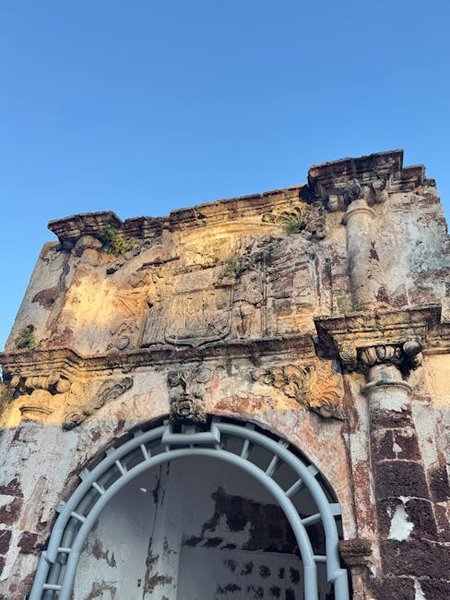
The Dutch layer is the one most physically evident today. Walk inside the shell of the church and run your hand along the walls. The rough, coral stone at the base? That’s often Portuguese. The neat, red bricks and tombstones with florid 17th-century Dutch script? That’s the Dutch renovation. They whitewashed the interior, added the distinctive stepped gable façade (a classic Dutch architectural feature you can see in Dutch colonial architecture across Asia), and filled the floor with elaborate tombstones for their elite. These aren’t just decorations; they’re territorial claims etched in stone. Every time I guide a friend here, I make them look at the tombstones. They tell stories of governors, merchants, and young children—a microcosm of the Dutch East India Company’s (VOC) society, frozen in time on a foreign hill.
How the Place “Works”: It’s All About the Climb
Technically, St. Paul’s Hill & Church is a heritage site managed by Malaysia’s museums department. But to think of it in just those terms is to miss its essence. The “function” of this place isn’t in its informational plaques. It’s in the process of experiencing it.
You start at the base, in the chaos of modern Malacca: the honking trishaws with their blaring pop music, the smell of chicken rice balls and durian. Then, you begin the climb. There are two main ways: the steep, direct staircase from behind the Stadthuys, or the more gradual, winding path past the Malacca Sultanate Palace replica. I always recommend the latter. The staircase is a brutal, sweaty assault. The winding path allows for a transition. With each step, the city noise fades, replaced by the chatter of monkeys and the rustle of rain trees. You’re not just walking up a hill; you’re ascending through time, leaving the 21st century behind.
Reaching the summit is the reveal. The church stands open to the elements, its roof gone, its floor a carpet of worn tombstones. Light and weather are its primary curators now. This is the “technical” reality: it’s a ruin preserved in a state of arrested decay. Conservation efforts focus on stabilizing the structure—ensuring the walls don’t collapse—not on restoring it. This is a crucial distinction. A restored church would be a museum piece. A stabilized ruin is a conversation between nature, history, and the visitor.
The final, masterful piece of the experience is the view. Walk through the church’s empty archway at the far end. You’ll emerge onto a terrace with a panoramic view of the Strait of Malacca. This is the payoff. This is why everyone fought over this lump of earth. You can see the modern port, the fishing boats, and the endless horizon. Standing there, you viscerally understand the hill’s strategic and symbolic power. It’s a viewpoint that explains five centuries of history in a single, silent glance.
Real-World Application: More Than a Photo Op
So, what’s it for today? For the average tourist, it’s a 20-minute stop, a few photos with the famous ruins, and a quick look at the view. But its applications run deeper.
For historians and archaeologists, it’s a non-renewable primary source. The mortar mix, the brick sizes, the graffiti carved by bored Dutch soldiers—it’s all data. I once spent a whole afternoon with a historian friend who was photographing the mason’s marks on the bricks, little symbols that could trace supply chains and workshops from 400 years ago.
For the local community, it’s a landmark of identity. It’s on the city’s coat of arms. It’s the backdrop for school trips and a favourite spot for couples and joggers at sunrise. Its image is reproduced on every conceivable souvenir. It has been absorbed into the cultural fabric of Malacca, transcending its colonial origins to become simply their hill.
And for people like me, and perhaps for you if you let it, it’s a tool for contemplation. In a world of constant noise and over-explanation, St. Paul’s offers none. There’s no audio guide, no reconstructed holograms. It’s just a quiet, empty space with a view. It forces you to fill in the blanks with your own imagination and knowledge. That’s its most powerful modern application: as an antidote to curated, spoon-fed heritage experiences.
The Advantages of Ambiguity (And the Disadvantages)
The great advantage of St. Paul’s is its authenticity as a ruin. It hasn’t been prettified. You can touch the same walls St. Francis Xavier might have leaned against. You see the scars of history—the bullet pocks some say are from WWII, the worn-down edges of tombs from millions of footsteps. This tangible connection is incredibly rare and potent.
Furthermore, its multi-layered history is a strength. It’s not a shrine to one empire or faith. It’s a testament to the successive waves that shaped Malaysia: indigenous, Portuguese, Dutch, British. This makes it a more honest and complex educational tool than a site celebrating a single, triumphant narrative.
However, this ambiguity is also its biggest challenge, or disadvantage. The lack of context can lead to profound misunderstanding. Without prior reading, what does a visitor see? A cool old building with a nice view. The deep narratives of conquest, cultural exchange, religious fervour, and economic ambition are invisible. The site risks becoming merely “picturesque,” its significance flattened into a social media backdrop.
The other major disadvantage is its fragility. Exposure is eating away at it. The soft laterite stone erodes with every monsoon rain. The foot traffic on the tombstone floor, while managed, is causing wear. Preserving a ruin in the open air, especially in a tropical climate, is a constant, losing battle against nature.
A Personal Case Study: The Empty Niche
Let me share a small, personal discovery that illustrates the joy of looking closely. On the northern interior wall of the church, there’s a row of empty, arched niches. For years, I walked past them, assuming they were just architectural features. Then, on one visit, the late afternoon sun hit them at a perfect oblique angle. Suddenly, I could see faint traces of frescoes—ghosts of colour and form. With some research, I learned these were likely side-altars with painted saints, whitewashed over by the Protestant Dutch.

This changed everything for me. The church wasn’t always this bare, monochromatic shell. It was once a colourful, vibrant, interior space, glowing with candlelight and painted icons. The Dutch Reformation wasn’t just a change of name on a deed; it was a physical act of scrubbing away one visual culture and imposing another. Now, every time I see those niches, I don’t see emptiness. I see a deliberate act of erasure, and beneath it, the faint, stubborn persistence of what came before. It taught me that at St. Paul’s, the most important stories are often the ones you have to work to see.
Common Pitfalls and How to Avoid Them
After dozens of visits and watching thousands of tourists, I’ve seen the common mistakes.
- The Rush Job: The biggest pitfall is not allocating enough time. Don’t just run up, snap a selfie, and run down. Give yourself at least an hour. Sit on the low wall. Watch the light change. Let the initial crowd clear.
- Ignoring the Context: Coming to the hill without understanding the city is a waste. Visit the Maritime Museum or the Baba & Nyonya Heritage Museum first. Understand Malacca’s role as a trading emporium. The hill will make ten times more sense.
- Missing the Details: Everyone looks at the big arch and the view. Few examine the tombstones. Get down on eye level. Look for the symbols: skulls and crossbones (memento mori), cherubs, coats of arms. Each tells a story.
- Forgetting the Fort: The church is the crown, but the hill is the body. The grassy slopes are the remnants of A Famosa fortress. Walk around. You’ll find crumbling bastions and walls being reclaimed by roots. The church is the headline act, but the fortifications are the supporting cast that made the story possible.
The Future: Preservation vs. Passion
The future of St. Paul’s is a tightrope walk. The greatest threat, in my opinion, isn’t neglect, but the wrong kind of attention. There’s always a temptation to “enhance” heritage sites—to add night lighting, sound-and-light shows, or augmented reality apps that pop up virtual Portuguese soldiers. For a place whose power lies in its austere, silent reality, this would be a disaster.
The best practice, which Malaysian heritage bodies have largely followed so far, is minimal intervention. Stabilize, conserve, and provide subtle, factual interpretation away from the immediate site (the excellent information boards at the base of the hill are a good example). Let the ruin speak for itself.
The challenge will be managing ever-increasing visitor numbers while protecting the fabric of the place. Perhaps timed entries or more robust pathways will be necessary. But the core philosophy must remain: protect the authenticity of the encounter. The magic of St. Paul’s is that it makes you feel like an explorer discovering something for yourself, not a consumer being led through a theme park.
Final Thoughts from the Hilltop
I’m writing this from memory, but I can feel the place: the coolness of the brick in the shade, the gritty texture of the tombstone under my palm, the specific smell of damp moss and old stone. St. Paul’s Hill & Church isn’t a monument to human triumph. If anything, it’s a monument to impermanence. Empires rose and fell, faiths changed hands, and all that remains is this beautiful, broken shell on a hill, slowly returning to the earth.
Yet, in that very impermanence lies its enduring power. It doesn’t boast. It doesn’t lecture. It simply is. It invites you to sit with the passage of time, to consider your own place in a story much larger than yourself. The next time you’re in Malacca, do more than visit it. Climb the hill slowly. Touch the walls. Read the stones. And stay long enough for the modern world to fade away. If you listen closely to the silence, you might just hear the echoes of all the dreams, prayers, and cannon fire that ever echoed around this timeless, sentinel hill.