The Red Heart of Malacca: Unpacking the Layers of the Stadthuys
I first saw it on a postcard, a decade before I ever set foot in Malaysia. A long, low-slung building painted a startling, almost violent shade of terracotta red, standing proudly against a deep blue sky. It looked like a piece of Amsterdam had been plucked from its canals and dropped, improbably, into the tropics. That image of the Stadthuys in Malacca stuck with me, a puzzle I needed to solve. What was this Dutch building doing in Southeast Asia? What stories were sealed within its thick, white-trimmed walls?
Years later, standing in the shadow of its clock tower, the humidity thick in the air, I realized the postcard had it all wrong. The Stadthuys isn’t a piece of Europe in Asia. It’s the opposite. It’s the physical, enduring record of Asia’s profound impact on Europe, a monument to the collision of worlds that created the modern global age. It’s not a transplant; it’s a hybrid, a crucible. And understanding it requires peeling back layers of paint, politics, and memory.
A Building Born from Ambition and Nutmeg
To call the Stadthuys simply a “Dutch town hall” is to miss the point entirely. Constructed between the 1640s and 1660s, it wasn’t built for a town in the conventional sense. It was the administrative nerve center for the Dutch East India Company (VOC) in Malacca, a fortress-city they had wrested from the Portuguese in 1641. The VOC wasn’t a nation; it was arguably the world’s first multinational corporation, with a private army, the power to wage war, and a ruthless focus on profit. The Stadthuys was its corporate headquarters for a critical region.
The location was everything. Malacca sat, and still sits, at the narrowest choke point of the Strait of Malacca. For centuries, it was the entrepôt—the warehouse—of the maritime world. Chinese junks, Indian dhows, Arab merchants, and later Portuguese carracks all converged here. Control Malacca, and you controlled the spice trade. You taxed every ship that passed. The Stadthuys, therefore, wasn’t designed for civic pride but for corporate control. Its solid, imposing structure was a statement of power and permanence to rival traders, local sultanates, and the lingering Portuguese influence.
Architecturally, it’s a fascinating study in impractical adaptation. The Dutch built what they knew: a massive, symmetrical structure with thick walls, large windows, and a steep, gabled roof designed to shed snow. There’s no snow in Malacca, of course, but there is torrential, monsoon-level rain, which the roof handles admirably. The thick walls, however, which in Holland retained heat, in Malacca became heat sinks, baking in the tropical sun. Walking through its cavernous, high-ceilinged rooms, you can feel the original folly—a European building fighting a losing battle with the equatorial climate. The solution, born of necessity, was the deep verandah that runs along the front. It’s a later addition, a distinctly tropical architectural feature tacked onto a Dutch core, creating shade and a cooler transitional space. This single addition tells you everything: the Europeans had to adapt to Asia to survive.
How the Stadthuys “Works”: More Than Bricks and Mortar
Today, the Stadthuys operates on several simultaneous levels, a palimpsest of functions that reveal its journey through time.
As a Museum Complex: This is its most visible role. The building houses the History and Ethnography Museum. Walking through its galleries is a disjointed but revealing experience. One room is dedicated to traditional Malay wedding customs, with exquisite gold-threaded songket fabrics and ornate ceremonial items. The next might display Dutch-era coins, porcelain, and weaponry. The curation itself is a historical artifact, reflecting a post-colonial nation’s attempt to reclaim a narrative. It says, “Before the Dutch, we were here with rich cultures. During the Dutch, this is what they left behind.” The building is the primary exhibit, its very fabric contextualizing the objects inside.
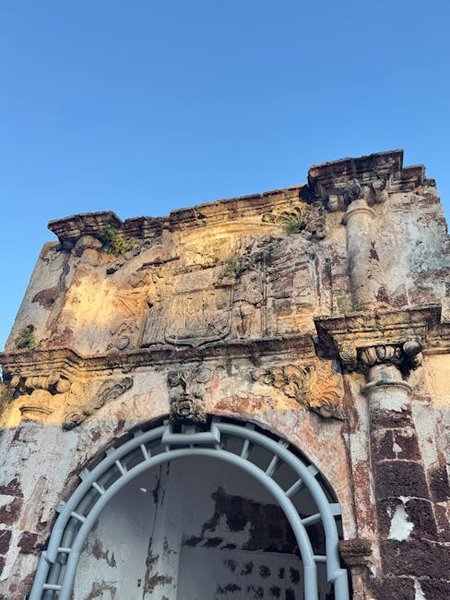
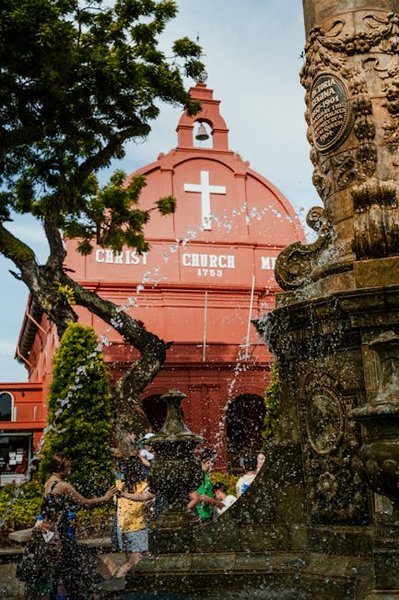
As a Spatial Anchor: The Stadthuys doesn’t exist in isolation. It’s the anchor of what is now the Dutch Square (or Red Square). To its left stands Christ Church, built by the Dutch in 1753. In front is the Tang Beng Swee Clock Tower (a Victorian-era addition) and the Queen Victoria Fountain. Behind it, up a punishingly steep hill, are the ruins of Porta de Santiago and St. Paul’s Church, remnants of the Portuguese era. The Stadthuys is the central, red pivot around which Malacca’s colonial history visibly rotates. It “works” by creating a physical timeline you can walk through in an afternoon.
As a Living Symbol: This is its most potent function. The building’s iconic red hue is a relatively recent phenomenon. It was likely whitewashed or a dull ochre for most of its history. The current vibrant red, applied in the British colonial period, has come to define it. It’s on every tourism brochure, every Instagram post. The color is a brand. It symbolizes Malacca’s UNESCO World Heritage status and its identity as a historical melting pot. The building “works” by being photogenic, by being a mandatory stop, by embedding itself in the visual memory of every visitor.
Lessons from the Ground: When History Gets Sticky
My most profound lesson at the Stadthuys didn’t come from a plaque. It came from trying to photograph it. Every afternoon, as the sun begins to dip, the square transforms. A hundred trishaws—bicycles festooned with fake flowers, blinking LED lights, and blaring pop music from mounted speakers—descend upon the square. They park in chaotic, colorful rows directly in front of the Stadthuys, waiting for tourists.
Initially, I was frustrated. My pristine shot of the historical monument was “ruined” by this garish, modern spectacle. But then I sat on the steps of the fountain and just watched. I saw families, laughing, piling into the trishaws for a tour. I saw the drivers, mostly older men, hustling for business. The thumping bass of a Justin Bieber song echoed off the 17th-century walls. And it clicked.
This is the real Stadthuys experience. It’s not a frozen museum piece. It’s a stage. The Dutch, Portuguese, British, Chinese, Indian, and Malay layers aren’t just in the past; they’re in the present, competing, blending, and creating something new and noisy and alive. The trishaws, with their over-the-top decorations, are a form of folk art and economic survival. Their presence in front of the solemn Stadthuys is a perfect, unscripted metaphor for modern Malacca: respectful of the past, but utterly engaged in the vibrant, sometimes chaotic, present.
A mistake to avoid is treating the Stadthuys as a mere checklist item. The pitfall is to walk through the museum, snap a photo of the red facade, and leave. You’ll have seen it, but you won’t have felt it. The best practice is to spend time in its orbit. Come in the morning when it’s quiet and the light is soft on the red walls. Go inside and read between the lines of the exhibits—ask what’s being said, and what’s being omitted. Then, return in the evening. Have a seat. Watch the square come alive. The building will mean something entirely different.
The Stadthuys in a Wider World: Comparisons and Context
In the realm of Southeast Asian colonial architecture, the Stadthuys is unique in its scale and preservation. Compare it to the British colonial buildings in Singapore or Kuala Lumpur. Those are often grander, neoclassical statements of imperial confidence—the Raffles Hotel or the Sultan Abdul Samad Building. They speak of a later, more industrial colonial age. The Stadthuys feels older, more mercantile, more fortified.
A closer comparison might be to Fort Cornwallis in Penang, a British star fort. But Fort Cornwallis is purely military. The Stadthuys was always civic-administrative, the place where taxes were counted, laws were pronounced, and trade deals were signed. Its true cousins are the VOC-era buildings in Jakarta (Old Batavia) or Galle Fort in Sri Lanka. Yet, many of those complexes are more ruined or fragmented. The Stadthuys’ completeness, its position as the centerpiece of a preserved urban square, gives it unparalleled narrative power.
Its disadvantage, from a purely historical perspective, is the very thing that makes it popular: its repainting and restoration. Purists might argue it’s too clean, too “theme-park.” The layers of grime, patchwork repairs, and weathering that told a deeper story have been covered by a uniform, cheerful red. It risks becoming a backdrop rather than a document. The challenge for conservators is balancing preservation with the building’s living, economic role as a tourist magnet.
The Future is a Conversation, Not a Preservation
I don’t see the Stadthuys fading into obsolescence. Its future is secure as Malacca’s primary landmark. The more interesting question is how it will be used and understood.
Will it remain a fairly traditional museum? Or could its spaces be used more dynamically? I’ve imagined temporary exhibitions that directly confront the building’s legacy—art installations by contemporary Southeast Asian artists responding to colonialism, soundscapes that mix 17th-century Dutch folk songs with Malay dondang sayang ballads. The building should be a catalyst for conversation, not just a container for artifacts.
The pressure from mass tourism is its biggest threat. The stone floors, worn smooth by centuries of feet, can only handle so many more. The management of visitor flow, of commercial activity in the square, of the physical impact of heat and humidity, will be an ongoing battle. The best future for the Stadthuys involves recognizing it not as a solitary treasure, but as the heart of a living, breathing historic city that needs careful, holistic stewardship.
Standing there for the last time on my most recent visit, as the evening lights began to illuminate its facade, I thought about the generations of people for whom this building was simply the seat of power—an inscrutable, foreign place of authority. Today, it’s a place of selfies and ice cream cones. There’s a strange democracy in that transformation.
The Stadthuys endures because it is adaptable. It was a Dutch corporate HQ, then a British administrative office, then a neglected relic, and now a beloved symbol. It has absorbed each new era, each new layer of paint and meaning. It teaches us that history isn’t a single story locked in a museum case. It’s an ongoing argument, a vibrant, noisy, and sometimes garish conversation that happens right in front of old, red walls. And that’s a far more interesting truth than any postcard could ever show.