The Sultan Abdul Samad Building: More Than Just a Pretty Facade
I remember the first time I stood before it, feeling utterly dwarfed. It wasn’t just the sheer scale, though that 41-meter clock tower certainly commands attention. It was the weight of history, the intricate dance of cultures in brick and plaster, and the quiet, persistent hum of a nation’s story being written within its walls. I’m talking, of course, about the Sultan Abdul Samad Building in Kuala Lumpur. For years, I’ve been drawn back to this spot, not just as a tourist with a camera, but as someone fascinated by the living dialogue between architecture and identity. My background in architectural history has led me to study many colonial-era structures, but this one is different. It’s not a relic; it’s a protagonist. It has witnessed riots and parades, housed the machinery of colonial administration and the birth of a nation’s judiciary, and now stands as the unshakeable anchor of Merdeka Square. To understand Kuala Lumpur—to feel Malaysia’s complex narrative—you have to start here.

From Colonial Seat to National Symbol: A Building’s Many Lives
To call the Sultan Abdul Samad Building merely a “colonial building” is to do it a profound disservice. Completed in 1897, it was conceived as the new Government Offices for the British Federated Malay States, a physical assertion of imperial order and permanence. The architect, A.C. Norman (with significant input from R.A.J. Bidwell of Swan & Maclaren), made a deliberate and, in hindsight, fascinating choice. Instead of replicating the purely Neoclassical or Gothic styles common in British India, he looked to the subcontinent for a different inspiration: Indo-Saracenic architecture.
This wasn’t just an aesthetic whim. The Indo-Saracenic style was a 19th-century British invention, a pastiche of Mughal, Islamic, and Indian elements. By employing it here—with its grand arches, chhatris (domed pavilions), and that iconic copper-clad onion dome—the British were engaging in a form of architectural diplomacy. They were building a symbol of authority that incorporated local visual language, perhaps hoping it would be more palatable. The irony is rich: a style invented by colonizers to legitimize their rule was eventually adopted and embraced by the colonized as part of their own national heritage.
The building’s journey mirrors Malaysia’s own. After housing various government departments, it became home to the Supreme Court and later the High Court. Its most famous moment came at midnight on August 30, 1957, when the Union Jack was lowered for the last time on the padang (field) opposite, and the Malayan flag was raised at the stroke of independence. The building, floodlit in the darkness, was the backdrop to the birth of a nation. Today, freed from its judicial functions after a meticulous restoration, it houses the Ministry of Information, Communications and Culture. Its role has shifted from administering law to curating culture—a poetic and fitting evolution.
The Architecture of Synthesis: Reading the Brick and Mortar
So, how does this building “work”? Not in a mechanical sense, but as a piece of communicative art. Walking its perimeter is a lesson in hybridity. The ground floor, with its series of deep, shaded verandahs supported by stout columns, is pure Anglo-Indian, designed for a tropical climate. Look up, and the language changes.
The most striking features are the triple-arched loggias on each wing, framed by bands of red brick and white plaster, creating a rhythmic, almost musical pattern. This banding is a direct reference to Mughal architecture, seen in masterpieces like the Red Fort in Delhi. Then come the chhatris, those little domed cupolas perched on the roofline. In Rajput and Mughal architecture, they denoted prestige and provided vantage points. Here, they break the skyline beautifully, adding a playful silhouette against the modern skyscrapers behind.
And then, the centrepiece: the 41-meter clock tower, affectionately nicknamed “Big Ben” by locals. Topped with a gleaming copper onion dome and a distinctive weather vane, it’s the building’s exclamation mark. The clock itself was a statement of modernity, imposing a standardized, colonial sense of time on the city. Today, its chimes are a familiar, comforting sound, a temporal anchor in a frenetic city.
The materials tell their own story. The distinctive red brick was imported from Bengal, while the white plaster was local. This combination created a striking colour scheme that became synonymous with Kuala Lumpur’s early civic architecture. The building isn’t just sitting on the land; it’s in a material conversation with it, blending imported technology with local context.
A Stage for the Nation: The Building in Application
The Sultan Abdul Samad Building’s primary application has always been symbolic. It is the definitive stage for national pageantry. Every year, on the eve of Merdeka Day (Independence Day), it forms the breathtaking backdrop for the national day parade. I was fortunate enough to witness this once. As dusk fell, the building was illuminated in a dynamic light show, with projections tracing Malaysian history across its facade. The juxtaposition was powerful: a 19th-century symbol of colonial power transformed into a 21st-century canvas for national pride. It was no longer just a building; it was a narrator.
Its second application is as an urban anchor. Along with the Royal Selangor Club and the National Mosque across the river, it defines the historic core of Kuala Lumpur, known as the Merdeka Square Historic Precinct. In a city whose development has often been haphazard, this precinct is a sacred, protected space. The building’s long, horizontal form and central tower provide a crucial sense of scale and orientation. In the chaotic visual noise of a modern Asian metropolis, it is a steady, grounding bass note.
Finally, its application is touristic and educational. It is the first stop for any visitor seeking to understand Malaysia. I’ve spent hours observing tour groups there. Guides don’t just list architectural features; they tell stories of the trials held inside, the protests that surged past its gates, and the moment the flag was raised. The building makes history tangible.
The Double-Edged Sword of Iconic Status
Its advantages are clear. It is a masterpiece of synthesis, a beautiful and unique architectural statement that successfully created a “Malaysian” style before the nation even existed. Its durability is proven; it has stood for over 125 years. Its adaptability is remarkable—from government offices to courts to a cultural ministry, its grand interior spaces have been repurposed while respecting its shell. Most importantly, its symbolic power is immense and positive, representing resilience, independence, and shared heritage.
But iconic status brings disadvantages. The first is the burden of preservation. The 2007-2012 restoration was a massive, costly undertaking. Maintaining such a historic fabric in a tropical climate, with its humidity and pollution, is a perpetual and expensive battle. The second is the challenge of context. The building was designed to dominate a low-rise colonial town. Today, it’s dwarfed by the PETRONAS Towers and the KL Tower. This creates a visual tension. Some see it as being overshadowed; I see it as a poignant dialogue between epochs, a reminder of the city’s layered history. The third disadvantage is more subtle: the risk of it becoming a mere postcard image, appreciated for its facade but with its complex history and interior life forgotten by the public who can no longer freely enter its halls.
A Personal Case Study: Chasing the Light
My most profound experience with the building wasn’t during a festival, but on a quiet, rain-washed Tuesday afternoon. I was researching the play of light on its facade. The banded brickwork, I realized, acts like a sundial. In the harsh midday sun, the contrast is stark and dramatic. But in the late afternoon, as the sun dips towards the west, something magical happens.
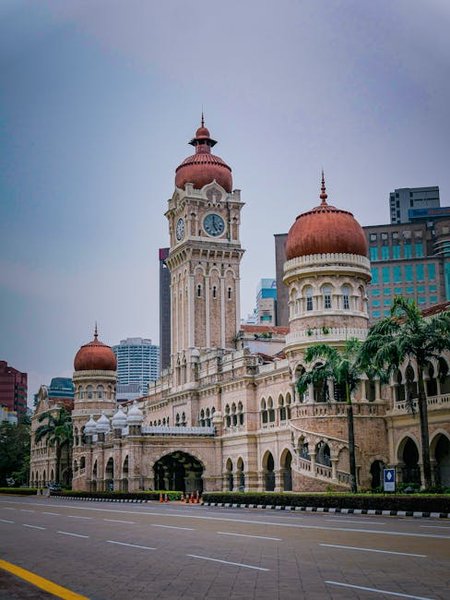
The low, golden light skims across the surface, deepening the red of the bricks to a burnt umber and making the white plaster glow. Each arch, each chhatri, casts long, stretching shadows that reveal textures and depths invisible at other times. On that particular day, a brief rain shower had just passed. The wet bricks shone like lacquer, and the puddles on the square in front reflected the entire building upside down, creating a perfect, shimmering double. For twenty minutes, I just sat and watched this silent performance. It was a reminder that this building isn’t static. It’s an environmental instrument, changing with the time of day, the weather, and the season. This intimate, quiet interaction taught me more about its design than any textbook could. The architects didn’t just design a form; they designed an experience of light and shadow.
The Moorish Revival Cousin: A Comparison with the Kuala Lumpur Railway Station
A natural comparison in KL is the Kuala Lumpur Railway Station, completed about 20 years later. Both are often lumped together as “Moorish” or “Indo-Saracenic.” But spending time with both reveals key differences. The Railway Station, designed by A.B. Hubback, is more fantastical, almost like a fairy-tale castle with its minarets, keyhole arches, and sprawling, asymmetrical plan. It feels more playful, more deliberately exotic.
The Sultan Abdul Samad Building, by contrast, is sober, dignified, and symmetrical. Its ornamentation is integrated into a fundamentally classical, balanced composition. The Railway Station whispers of adventure and departure; the Sultan Abdul Samad Building speaks of law, order, and permanence. One is a gateway, the other a seat of power. This comparison highlights that the “Indo-Saracenic” label isn’t monolithic; it could be adapted to express vastly different functions and tones.
Common Pitfalls in Appreciating the Building (And How to Avoid Them)
Over the years, I’ve noticed common mistakes people make when engaging with this landmark.
The Snap-and-Go: The biggest pitfall is treating it as a mere photo op from across the square. You get the classic shot with the flagpoles, and you move on. How to avoid it: Walk. Walk its entire perimeter. Notice how the perspective changes from the front to the side along Jalan Raja. Get up close and study the brickwork, the plaster details, the weathered copper of the domes. See the later additions and the scars of time.
Seeing it as Purely “British”: Dismissing it as a colonial imposition misses the point. How to avoid it: Research the Indo-Saracenic style. Understand it as a hybrid, a conversation (however imbalanced). Look for the specific Indian and Islamic elements. This reframes the building from a symbol of oppression to a complex artifact of cultural exchange.
Ignoring the Context: Viewing the building in isolation. How to avoid it: See it as part of an ensemble. Turn around and look at the Royal Selangor Club’s Tudor-style building. Look at the Gothic revival of St. Mary’s Cathedral nearby. This cluster tells the story of a colonial administration building its “little England” but doing so with an adapted architectural vocabulary.
Forgetting it’s a Workplace: It’s easy to see it as a museum piece. How to avoid it: Remember that people work there. During weekdays, you’ll see civil servants entering and leaving. This liveliness is crucial. It prevents the building from becoming a dead monument and ensures its preservation is functional, not just cosmetic.
The Future: Steward, Not Museum Piece
The future of the Sultan Abdul Samad Building lies in continued, sensitive stewardship. The restoration work has given it a new lease of life for decades to come. The challenge now is narrative. How do we keep its stories alive for generations of Malaysians who may see it as an old, familiar fixture?
I believe the key is in finding new ways to connect the public with its interior. Could there be curated public open days for the grand halls? Could augmented reality apps, activated on the square, overlay historical images and tell stories of key events? The building must continue to evolve as a cultural venue, perhaps hosting more public exhibitions or events that relate to its history in its ground-floor spaces.
Furthermore, as Kuala Lumpur continues to grow, the protective “buffer zone” around the Merdeka Square precinct must be fiercely defended from inappropriate development. The building’s dignity depends on its setting.
Standing there now, as the evening lights begin to warm its facade, the Sultan Abdul Samad Building feels like an old friend who has seen it all. It has been a tool of empire, a witness to liberation, a working court, and now a keeper of culture. Its genius is in its silent flexibility. It absorbs meaning without being erased by it. For me, it is the ultimate lesson in how architecture can transcend its original intent. It teaches us that buildings are not just made of brick and mortar, but of memory and meaning, constantly being remade by the people who live around them, walk past them, and see in them a reflection of their own story. It’s not the tallest or the shiniest building in Kuala Lumpur, but I’d argue it remains the most important. It is the city’s foundation stone, its face to history, and its unwavering heart.